
When it is time to send data from Bosbec to System B, much of the process should feel familiar from the chapter Get data via API. In most cases, sending data is done by making an HTTP request to an endpoint exposed by the receiving system and authenticating using one of the methods described in Authentication methods.
The main difference compared to retrieving data lies in the HTTP method and the inclusion of a request body. When fetching data from System A, we typically use a GET request. When sending data to System B, this is most often done using a POST request, along with the data that should be transferred.
Configuring a POST request
In the example below, you can see how a Send HTTP Request job is configured to perform a POST request to System B.
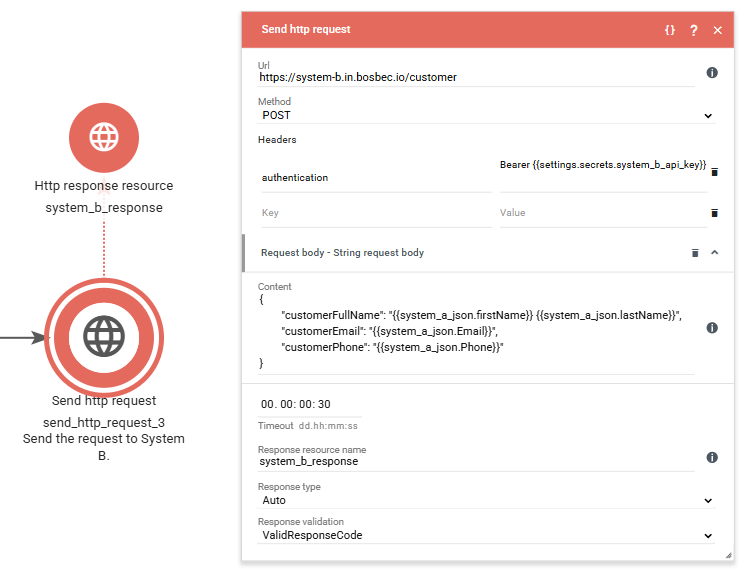
This is a simple example where we construct a field called customerFullName by concatenating firstName and lastName when we send the request. The resulting payload is then sent directly to System B.
This pattern is common when System A and System B have slightly different data models and a lightweight transformation is required before forwarding the data.
Handling multiple records and batching
In more advanced scenarios, the incoming data may contain:
- An array of multiple customers that need to be sent to System B, or
- A large number of records that must be sent in smaller batches to avoid rate limiting or performance issues in the receiving system
These cases can be handled using looping constructs such as For Each Resource and delays, which allows you to iterate over groups of units or json objects and send records individually or in controlled batches.
Alternative delivery methods
Bosbec also supports sending data via files or email. These delivery methods are useful in certain integration scenarios but fall outside the scope of this guide, which focuses primarily on API-based integrations between System A and System B.
In the next chapter, we will go through Best practices and tips, with concrete examples of how to design robust, maintainable workflows in Bosbec.